Why rapid weight loss ages the face
How weight-loss injections change the face, and how it is rebuilt.
Rapid weight loss changes the face before it finishes changing the body. The reason is structural, not cosmetic. The face is held up by discrete pads of fat that sit between muscle and skin, and weight-loss medication empties those pads faster than the overlying skin can adapt. The result reads as sudden ageing: a hollower midface, a softer jawline, skin that looks looser than it did a few months earlier. This guide explains what is happening at each layer, and how it is addressed.
Treatments referenced here are for adults aged 18 and over. The London Road Clinic does not prescribe or provide weight-loss medication. This guide is about its effect on the face.
Reviewed by Dr Shahe Boghossian, GMC 5204600, Medical Consultant. Last reviewed 6 Aug 2026.
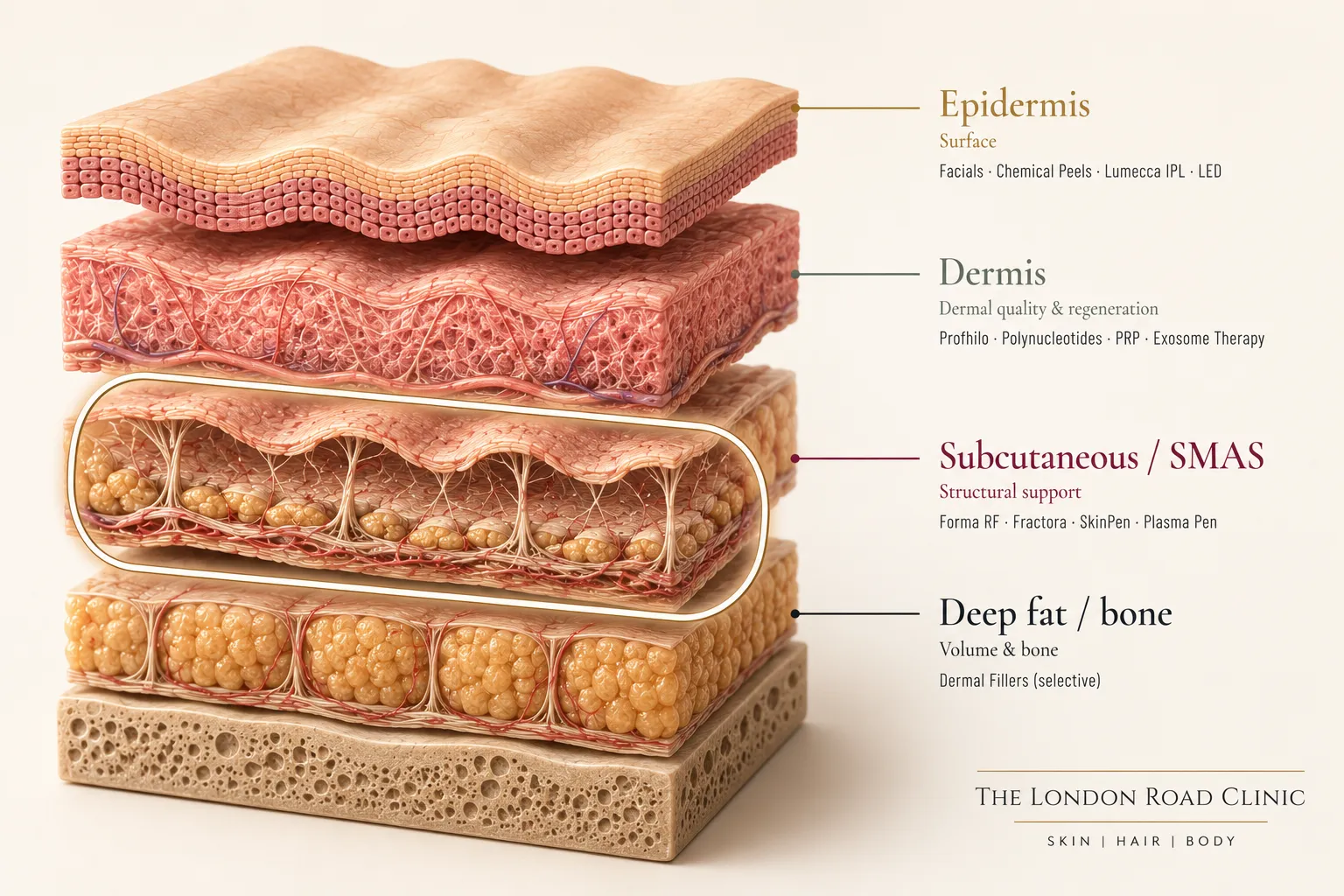
The same four layers, under accelerated stress.
In Skin Architecture we set out the four structural layers of facial ageing. Rapid weight loss does not introduce a new process. It compresses the existing one into months instead of years, and it loads the deeper layers first.
Fat compartments
The face is supported by separate pads of fat, deep and superficial, that give the cheek its projection and the jaw its line. Rapid weight loss empties these compartments because they are the same fat the medication targets.
Deep and superficial fat pads
Structural support
As the deep pads deflate, the tissue above has less to rest on. The midface flattens, the folds beside the nose deepen, and the lower face begins to descend slightly under its own weight.
SMAS, deeper connective tissue
Dermal quality
Skin retracts slowly, and less well with age. Collagen and elastin are already declining before any weight is lost, so skin that loses its scaffolding over weeks has no time to shrink to fit.
Dermis, collagen and elastin network
Surface
What the mirror shows is the sum of the three layers beneath it: less volume, less support, less recoil. The face has not aged a decade. It has lost its underpinning quickly, and the surface is simply reporting it.
Epidermis and skin surface
What changes, and how fast.
Skin loses collagen at roughly 1% a year in adulthood, with a steeper fall of around 30% in the five years after menopause. That decline sets how well skin can retract when it is asked to, and it is already underway before any weight is lost.
Against that baseline, the effect of rapid medical weight loss is now being measured. In a physician survey reported by Allergan Aesthetics in 2026, approx. 61% of patients on weight-loss medication showed midface volume loss and approx. 50% reported skin laxity, with around 63% of those seeking facial treatment afterwards new to aesthetic care. The underlying physiology, hollowing across the midface, temples and under-eye with increased laxity, is set out in the peer-reviewed clinical literature.
The figures are worth holding lightly. They describe a population, not an individual, and the percentages come from early survey data that is still settling. What is not in doubt is the mechanism.
Sources: Shuster, Black & McVitie, Br J Dermatol, 1975. Brincat, Maturitas, 2000. Aesthetic Surgery Journal Open Forum, 2026.
~1%
Approximate annual decline in skin collagen from early adulthood, the baseline that sets how well skin can retract.
Shuster, Black & McVitie, Br J Dermatol, 1975
~30%
Dermal collagen lost in the first five years after menopause, before any weight change is added.
Brincat, Maturitas, 2000
A structured approach, not just refilling.
The instinct is to put the volume back. On its own that is the wrong answer, because filling a face that has also lost skin quality and support produces a heavy, worked result. A clinical plan reads all three layers and treats in order. The order matters more than any single treatment.
| Layer | What patients notice | LRC treatments |
|---|---|---|
| Skin quality first | Loss of bounce, crepey texture, skin that looks loose after fast weight change | |
| Structural tightening | Lower face softening, laxity once volume and quality are being addressed | |
| Selective volume | True volume loss from the deep fat pads, restored last and sparingly |
Every plan begins with an in-person consultation, and treatment is recommended only after your skin has been assessed. Treatments are for adults aged 18 and over.
Treatments that rebuild quality and support.
Profhilo Skin Booster
Bio-remodelling treatment that disperses through the dermis to stimulate collagen and elastin production.
From £250 Skin qualityPolynucleotides
DNA-fragment regenerative treatment using Croma Polyphil by Croma Pharma.
From £195 Skin qualityPRP
Uses your own growth factors to support tissue repair and skin quality.
From £250 StructuralForma RF
Non-ablative radiofrequency that heats collagen fibres to produce immediate tightening and longer-term remodelling.
From £120 StructuralSkinPen Microneedling
FDA-cleared and NICE-assessed microneedling device for collagen induction.
From £200 Selective volumeDermal Fillers
Hyaluronic acid filler placed to rebuild structural support where the deep fat pads have emptied, not to inflate the surface.
Price at consultationStart here
Build the plan on your settled face. Book an Observ skin analysis.
The Observ 520 uses multispectral imaging to map pigmentation, vascular activity and surface quality, giving a clear baseline to plan against and to measure progress from.