Skin Architecture
Understanding how skin ages beneath the surface.
Skin architecture is a clinical way of understanding that skin ages at several levels at once. Collagen, elastin and tissue quality change over time, affecting everything from surface texture to the structural support underneath. A skin health approach assesses all of those layers, not only what is visible, then plans treatment around them.
Reviewed by Dr Shahe Boghossian, GMC 5204600, Medical Consultant. Last reviewed 6 Aug 2026.
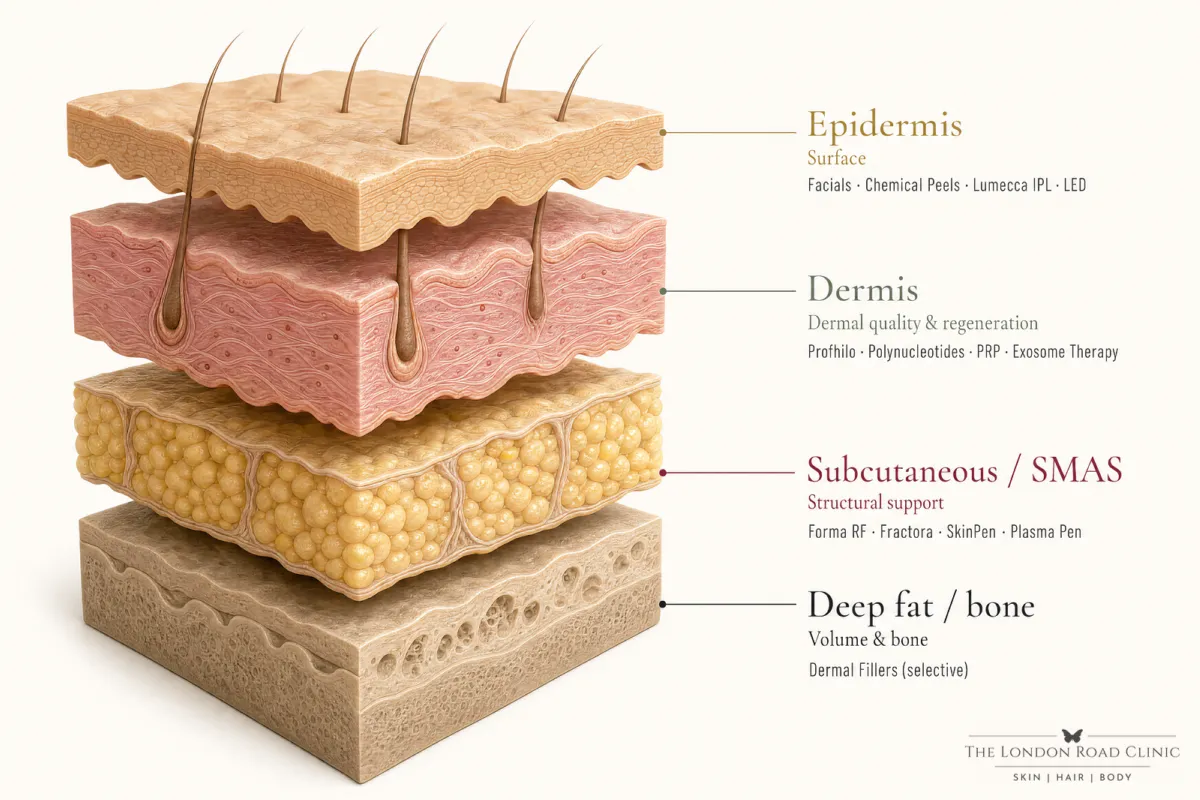
Four layers. Four different kinds of change.
Think of skin the way you would think of a building. The paint on the walls is what you see first. How the building ages depends on far more than the paint. The same is true of skin.
Surface
Texture, tone, pigmentation and clarity. This layer responds well to skincare, peels, IPL and light-based treatments. It is the most visible and the most treatable.
Epidermis and skin surface
Dermal quality
Hydration, bounce and elasticity live in the dermis. When collagen and elastin fibres thin and disorganise, skin looks crepey, dull and less resilient, even without obvious lines.
Dermis, collagen and elastin network
Structural support
The SMAS and deeper connective tissue form the framework. As they loosen, the lower face softens and the midface descends. This layer needs active remodelling, not surface treatment.
SMAS, deeper connective tissue
Volume and bone
Fat compartments deflate and bone gradually resorbs with age. Where true volume loss exists, selective replacement can restore proportion, but only after the layers above it have been addressed.
Fat compartments, facial skeleton
What changes with age, and when.
Skin collagen declines by roughly 1% a year from early adulthood. By the time the change is visible, it has usually been building quietly for years. Skin that looks fine at 35 may already have lost a meaningful share of its collagen density.
The rate accelerates around the menopause. Studies suggest about 30% of dermal collagen is lost in the first five years, alongside a marked drop in skin thickness, elasticity and wound-healing capacity.
These shifts happen at a cellular level before they reach the surface. That is why the most useful clinical approach starts by assessing what is happening beneath the skin. That is the purpose of a skin architecture consultation at LRC, including an assessment on the Observ 520.
Sources: Shuster, Black & McVitie, Br J Dermatol, 1975. Brincat, Maturitas, 2000.
~1%
Approximate annual decline in skin collagen from early adulthood.
Shuster, Black & McVitie, Br J Dermatol, 1975
~30%
Dermal collagen lost in the first five years after menopause.
Brincat, Maturitas, 2000
How we approach skin health at LRC.
A skin architecture consultation begins by identifying which layer, or combination of layers, needs attention. The table below shows how each clinical layer maps to the treatment menu.
| Layer | What patients notice | LRC treatments |
|---|---|---|
| Surface polish | Uneven tone, dull complexion, redness, sun damage | |
| Dermal quality and regeneration | Crepey skin, loss of bounce, poor hydration, fine crinkling | |
| Structural tightening and remodelling | Lower face softening, skin laxity, collagen depletion | |
| Selective volume | True volume loss remaining after quality and support are addressed |
Treatments that address skin at a structural level.
Profhilo Skin Booster
Bio-remodelling treatment that disperses through the dermis to stimulate collagen and elastin production.
From £250 Dermal qualityPolynucleotides
DNA-fragment regenerative treatment using Croma Polyphil by Croma Pharma.
From £195 Dermal qualityPRP
Uses your own growth factors to support tissue repair. Available for facial skin quality and hair restoration.
From £250 Dermal qualityExosome Therapy
BLESKIN EXXO via Glo Skin Beauty UK&I. May support skin recovery. The evidence is early-stage.
From £450 StructuralForma RF
Non-ablative radiofrequency that heats collagen fibres to produce immediate tightening and longer-term remodelling.
From £120 StructuralFractora RF Microneedling
Fractional radiofrequency delivered via a microneedle array. A medical procedure delivering controlled dermal injury for deep collagen remodelling.
Price at consultation StructuralSkinPen Microneedling
FDA-cleared and NICE-assessed microneedling device for collagen induction.
From £200 StructuralPlasma Pen (Plaxel+)
Plasma fibroblast treatment for non-surgical skin tightening.
From £70Start here
See your skin architecture. Book an Observ skin analysis.
The Observ 520 uses multispectral imaging to reveal what is happening beneath the surface of your skin, including pigmentation, vascular activity and texture changes invisible to the naked eye.