Body treatment
Emsella Pelvic Floor Treatment in Newark
A discreet, non-invasive treatment for bladder leakage, urge symptoms and reduced pelvic tone. Fully clothed, 28 minutes, no downtime.
- Price
- From £120per session. Course of six, £600


Amazing - Jaz was so lovely and couldn't do more for me. She checked I was ok with the machine I was using, made me a lovely latte and put Friends on for me :) Will definitely be back! Leigh
Verified Fresha review, displayed as submitted.
- Price
- From £120 per session. Course of six, £600
- Duration
- 30 mins
- Results
- Many people notice change within the first two to three weeks. The strongest improvement is usually apparent six to eight weeks after the final session
- Longevity
- Results are muscular, so they need maintaining. Most people continue pelvic floor exercises and consider a top-up session or two each year
The treatment
Emsella Pelvic Floor Treatment: how it works
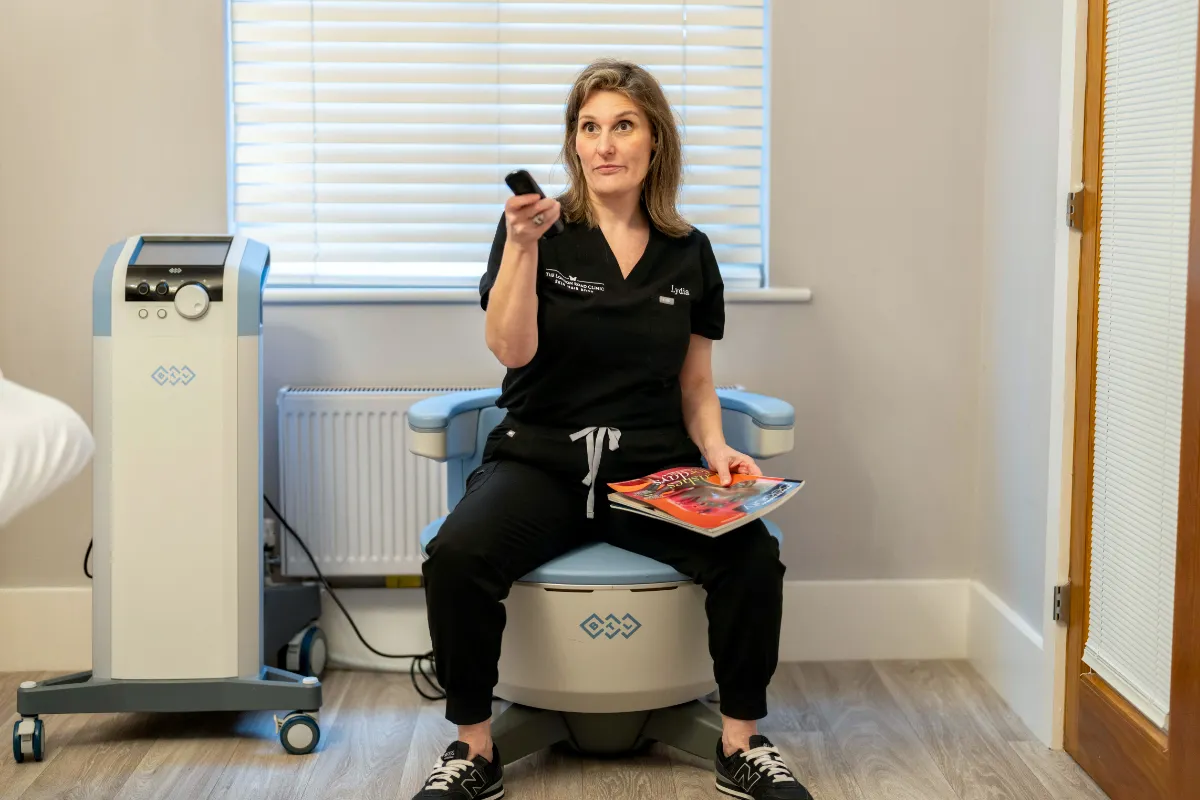
Emsella uses high-intensity focused electromagnetic energy, usually shortened to HIFEM. You sit fully clothed on a purpose-built chair while the device generates a focused electromagnetic field beneath you. That field drives the pelvic floor into supramaximal contractions, meaning contractions stronger and more complete than voluntary effort can produce, because the field bypasses the conscious neuromuscular pathway entirely. Thousands of these contractions occur in a single 28-minute session. The muscular response is the same as the response to progressive resistance training elsewhere in the body: the fibres strengthen, and the reflex that closes the pelvic floor against sudden abdominal pressure becomes better coordinated. That reflex is what fails when you leak on a cough or a sneeze.
What patients notice
What to expect
- Strengthens the pelvic floor without relying on correct exercise technique
- Fully clothed throughout, with no intimate exposure or examination
- Addresses stress leakage, urge symptoms and mixed patterns of both
- 28-minute sessions with no downtime and no recovery period
- Suitable for men as well as women, including after prostate surgery
- Screening consultation first, so you are told if it is the wrong answer
Before you book
Is this treatment right for you?
Suitable for
- Adults with pelvic floor weakness, stress leakage on coughing, sneezing, laughing or lifting, urge symptoms, mixed incontinence, post-pregnancy pelvic changes that have not resolved with exercise, perimenopausal or postmenopausal pelvic symptoms, or men with leakage following prostate surgery.
Not suitable for
- Not appropriate during pregnancy, or where metal implants, a copper coil or a pacemaker are present. Not a treatment for pelvic organ prolapse, and not a substitute for urological assessment where there is blood in the urine, pain, or incontinence following recent surgery. Full screening is carried out before treatment is agreed.
After your appointment
Aftercare
There is no downtime and no restriction on activity. Some people notice mild muscular tiredness in the pelvic region afterwards, much like the feeling after sustained exercise. We recommend continuing pelvic floor exercises alongside and after the course, because the results are muscular and need maintaining.
What the evidence shows
One 28-minute session delivers the equivalent of 11,200 Kegel exercises. You could not reproduce that in months of practice at home, and that is the point.
In a study of 75 women published in Lasers in Surgery and Medicine, six sessions produced:
After a course of six sessions
- 81%
- reported a significant reduction in symptoms
- 64%
- improvement in symptom score at three months
- 54%
- reduction in pad use at three months
- 70%
- improvement in mixed incontinence
Samuels JB, Pezzella A, Berenholz J, Alinsod R. Lasers in Surgery and Medicine 2019;51(9):760-766. PMID 31172580. Individual results vary.
Symptom scores improved by 49.93% by the end of the course and 64.42% at three-month follow-up, so the benefit kept building after treatment stopped. Pad use fell 43.80% by the sixth session and 53.68% at three months, with 70% of patients using fewer pads. Patients reported no pain, no downtime and no adverse events.
BTL, who manufacture the device, report 95% of patients seeing an improvement in quality of life and a 75% reduction in pad use.
The wider evidence base holds up. A 2025 systematic review and meta-analysis in Neurourology and Urodynamics pooled seven studies and confirmed a significant improvement in ICIQ-UI SF scores against control (PMID 39760417), and a 2025 study in Therapeutics and Clinical Risk Management covers men after prostate surgery (PMID 40909763). The device is CE-marked and FDA-cleared.
Individual results vary, which is what the screening consultation establishes.
Pelvic floor problems are among the most undertreated things we see, and among the most worth addressing. People accept leakage as the price of childbirth or menopause because the conversation feels awkward. It is not the price of anything. The majority of people who complete a course report a meaningful reduction in symptoms, often sooner than they expected.
Lydia Griffin, Clinic Director
What changes day to day
Coughing, sneezing, laughing and lifting without bracing for it. A run, or the trampoline with the grandchildren, without mapping the route to a bathroom first. Sleeping through instead of getting up twice. For men treated after prostate surgery, the same strengthening applies.
Six sessions across three weeks, 28 minutes each, fully clothed. You can book one into a lunch break and go straight back to work.
Who we screen out
Emsella strengthens muscle, so it will not repair structural damage to the sphincter mechanism that needs surgical correction, and it does not treat pelvic organ prolapse, which needs assessment by a urogynaecologist or pelvic floor physiotherapist.
It is not suitable during pregnancy, or where there are metal implants, a copper coil or a pacemaker. Blood in the urine, pelvic pain, or incontinence that started after recent surgery should be assessed by a GP or specialist first. We check all of this at the screening consultation so you begin a course knowing it suits you.
Further reading: Emsella compared with pelvic floor physiotherapy, and the full patient guide to Emsella and pelvic floor treatment.
How we plan your course
Every course starts with a screening consultation. That covers your symptom pattern, your obstetric and surgical history, any implanted devices, and whether the picture fits functional pelvic floor weakness or something that needs investigating first.
If Emsella is appropriate, the standard course is six sessions, two per week across three weeks, which is the protocol used in the published literature. Sessions are 28 minutes and you can fit one into a lunch break. You keep your clothes on, you sit down, and you leave straight afterwards.
Pricing is £120 per session or £600 for a course of six. There is no downtime and no aftercare beyond continuing your pelvic floor exercises, which we do recommend, because the gains are muscular and muscular gains need maintaining.
Background on the underlying concern: pelvic floor weakness and incontinence.
Where our Emsella patients travel from
The clinic is at 65 London Road, Newark-on-Trent, NG24 1RZ, with free parking at the front.
A six-session course means six visits in three weeks, so travel time matters more than it does for a one-off appointment. We are within a straightforward drive of Balderton, Farndon, Collingham, Southwell, Bingham and Ollerton in Nottinghamshire, and of Lincoln, Grantham and Sleaford in Lincolnshire. Sessions are 28 minutes and you stay dressed throughout, so a lunchtime appointment is realistic if you are travelling in from work.
If you are coming from further out, we can usually group the two weekly sessions to suit the drive. Say so when you book and we will plan the course around it.
A course means several visits to the clinic. If you live near Lincoln or Grantham, the page for your town shows how far it is and how to get here.
Common questions
Frequently asked about Emsella Pelvic Floor Treatment
How much does Emsella cost in Newark?
How many Emsella sessions will I need?
Does Emsella hurt?
Do I need to undress for Emsella?
When will I notice a difference?
Can men have Emsella?
Is Emsella better than pelvic floor exercises?
Who is not suitable for Emsella?
Do I need a GP referral?
How long do the results last?
Sources (3)
- Noninvasive High-Intensity Focused Electromagnetic Therapy in Women With Urinary Incontinence: A Systematic Review and Meta-Analysis. Neurourology and Urodynamics, 2025. PubMed 39760417
- Safety and Efficacy of a Non-Invasive High-Intensity Focused Electromagnetic Field (HIFEM) Device for Treatment of Urinary Incontinence and Enhancement of Quality of Life. Lasers in Surgery and Medicine, 2019. PubMed 31172580
- Evaluating the Efficacy of High-Intensity Focused Electromagnetic (HIFEM) Therapy for Postprostatectomy Incontinence in Men. Therapeutics and Clinical Risk Management, 2025. PubMed 40909763